How an operational scent is developed: from the laboratory to the field
29 de April de 2026
SUMMER TRAINING: THE CONSEQUENCES OF HEAT ON DOG TRAINING
29 de July de 2026
What do we mean by odor generalization? Odor generalization is the dog’s ability to reliably identify a target substance despite variations in its composition, matrix, or excipients. This means the dog learns to respond to the common olfactory components associated with the target substance, even when it appears in different formulations or mixtures. It does not imply the creation of a generic olfactory category for explosives or drugs, but rather the ability to detect the same substance in its various forms.
In practice, this concept is fundamental, since due to availability, logistics, or access to reference materials, a single stable sample is not always used. It is common to encounter heterogeneous materials: different origins, varying purity levels, or different compositions of the same substance.
Therefore, the goal of training is not for the dog to memorize specific samples, but rather to be able to extract the common olfactory pattern among them, that is, the characteristic “signature” of the target substance.
Practical Example
If we want to train a dog to detect a target substance, for example, cocaine, we encounter common situations of variability in the available material during the process: in the first phase, a sample from a single seizure or specific location is used as an initial reference; subsequently, cocaine samples containing cutting agents or interfering substances that partially modify their composition are introduced; and finally, material from different sources is used, in which the degree of purity and adulteration patterns can vary significantly.
Despite these differences, the goal of the training is not for the dog to distinguish each of these presentations as independent categories, but rather to be able to recognize them as manifestations of the same target substance, in this case, cocaine, by identifying the common olfactory elements that allow them to be classified as belonging to the same target substance, regardless of their origin or composition.
Analogy between senses: canine sense of smell and human color vision
A simple example to understand olfactory generalization in dogs is human color vision, that is, the perception of colors. If we observe different shades of blue (for example, light blue, dark blue, or turquoise) (Illustration 1), we do not perceive exactly the same hue in each case, but we are able to group them within the same perceptual category, identifying them as “blues.”

Illustration 1: Range of blues
For this categorization to be possible, it is necessary to have previously learned what is understood as a color reference; that is, to have internalized “blue” as a base category through consistent examples. From there, the perceptual system is able to recognize its different variations as equivalent.
A comparable process occurs in the case of canine olfaction. The dog must first learn to recognize the characteristic odor of the target substance under controlled conditions, thus establishing a stable reference. However, in practice, this stimulus is not always presented in the same way: the same substance can generate different olfactory profiles depending on its degradation or its mixture with other compounds. In this way, the dog does not respond to a single, fixed olfactory signature, but rather learns to group together as belonging to the same olfactory category those variations that are related to the target substance, thus extending recognition beyond a single form.
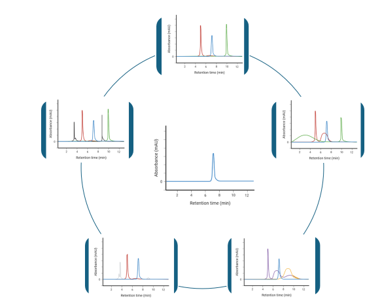
Illustration 2: Grouping of different profiles into the same category.
How is this generalization achieved in dogs?
Ideally, training should begin with the target substance in its purest form, avoiding complex matrices or added substances that could introduce unwanted secondary olfactory cues. This allows for more direct learning of the relevant odor, reducing incorrect associations. Once this foundation is established, it is appropriate to gradually introduce different presentations and mixtures in which the target substance is combined with other components, in order to broaden the recognition range and reinforce a more robust olfactory representation. However, the variability introduced must be controlled, as excessively broad or unstructured exposure can promote overgeneralization, in which the dog begins to respond to unwanted stimuli that share certain characteristics with the training samples.
In the case of training with the pure substance, special attention must be paid when additional substances capable of masking the odor of the target substance are present. When these compounds generate a more intense olfactory signal for the dog, potentially leading to saturation, there is a risk that an incorrect association will be established during training, causing the animal to respond to the odor of the masking agent instead of the substance being detected. If this exposure occurs repeatedly, the dog may develop an incorrect association, based primarily on these secondary compounds. Consequently, in operational situations where these masking substances are not present, detection capability may be compromised, increasing the risk of false negatives. Therefore, it is essential to know exactly what the dog is being trained with, since this will determine whether the generalization is built on the target substance and not on secondary stimuli that may generate erroneous associations.

Illustration 3: Ideal process for odor generalization.
However, in practice, this order is not always possible, and the process is reversed. In these cases, the dog is trained directly with multiple samples in a mixture, so that all must be interpreted as belonging to the same olfactory category. This approach is more demanding, as it requires identifying what is common among chemically different compositions, instead of starting with a clearly defined reference material and progressively increasing its variability.

Illustration 4: The reverse but common process of odor generalization.
In both cases, it is essential to accurately identify the olfactory profiles used during training, as the proper development of the generalization process depends on them. This control is especially important because, sometimes, a sample may not contain the target substance due to labeling errors, degradation, or alterations during storage or handling. Consequently, the quality and characterization of the samples used not only influence the dog’s initial learning but also the scope and reliability of the generalization it will subsequently develop.