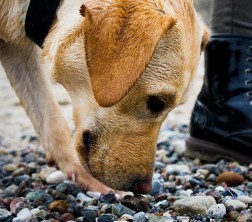
DEX and C-IED dogs put the TATP Training Kit to the test in CANEX 02/25 exercises
3 de December de 2025
🐕🔬 Decoding the ‘Scent’ of COVID-19
3 de February de 2026
In Spain, New Year’s Eve is celebrated on December 31st, a day to say goodbye to the old year and welcome the new one. For over a century, this moment has been marked by a well-known tradition: during the first 12 seconds of the new year, 12 grapes are eaten, one for each chime of the clock. The broadcast of the New Year’s chimes is traditionally from the Puerta del Sol in Madrid, via television and, nowadays, also through streaming platforms. Every year, this iconic location becomes a meeting point for thousands of people who celebrate the start of the new year together, in a scene that is repeated regularly and with great anticipation.
However, there is another element that is also part of this annual event and that is rarely visible to the public: the prior work of the sniffer dogs.
Before the gates open, a complex and highly specialized security operation is deployed. Within this operation, explosive detection dogs play an essential role: verifying that the space meets the necessary security conditions before the mass entry of attendees.
The canine teams begin their work several hours in advance. Inspections are carried out systematically and according to established procedures, covering the plaza and its access areas. Critical points are checked, such as entrances, gathering areas, street furniture, trash cans, authorized vehicles, and any space that could potentially pose a risk. Upon detecting a specific odor, the dog indicates the location through trained and recognizable behaviors to its handler, who assesses the situation and coordinates the corresponding actions with the rest of the team. The accuracy of this communication is crucial to the effectiveness of the operation.
For these types of operations, dogs with very specific profiles are selected: stable, focused animals capable of maintaining reliable performance, able to identify specific odors and ignore irrelevant stimuli. They must work in complex environments characterized by noise, intense lighting, crowds, and high operational pressure, in order to operate accurately in real-life scenarios like the New Year’s Eve celebrations.
Before the grapes are eaten, before the cameras are set up, and before the start of the festivities, the detection dogs have already patrolled the area to verify that everything is safe. Thanks to their intervention, thousands of people can gather peacefully to celebrate the arrival of 2026.