Odor Generalization
25 de June de 2026
The importance of working with blanks and distractors
3 de September de 2026
The recent heat wave has brought to the forefront an important issue for those who work with detection dogs: heat can have direct consequences on training, as it affects both the dog and the scent of the substance. Understanding how both change is fundamental to adapting training and avoiding misinterpreting the performance of the dog-handler team.
- Higher Temperature ≠ Easier Training
When the temperature rises, the volatility of many volatile organic compounds (VOCs) also increases.
Related to the perception and dispersion of odor, and especially in the field of dog training, there are numerous environmental factors that directly influence olfactory performance, such as temperature, humidity, and drafts.
If we analyze these factors individually, temperature is closely related to the volatility of substances. As the temperature increases, volatility also increases exponentially. This occurs because the molecules responsible for the odor more easily transition to the gaseous phase and reach the air more quickly.
In practical terms, an increase in temperature causes a greater release of VOCs, thus increasing the number of odor molecules available in the environment. As a result, the dog can detect the sample more easily.
However, this phenomenon also has important implications when applied to training devices or materials. With a greater release of VOCs, the reserve of volatile compounds is consumed more rapidly, reducing the aid’s effective working time. In other words, higher temperatures lead to greater evaporation, meaning the odor changes more quickly and the source loses compounds faster.
For this reason, it is especially important to respect the usage times indicated for each device and avoid unnecessary exposure to heat.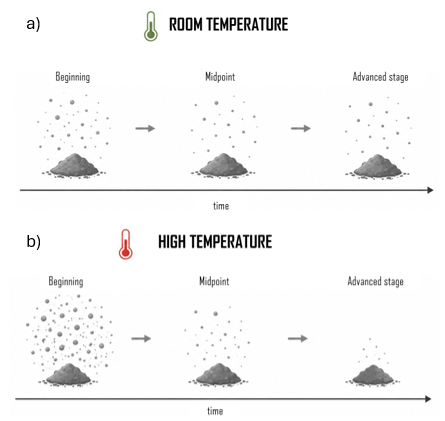
Figure 1. Schematic representation of the effect of temperature on the release of volatile organic compounds. a) Room temperature: gradual and sustained release of VOCs and b) High temperature: greater initial release of VOCs, followed by a faster depletion of the odor source.
In addition to accelerating the evaporation of volatile compounds, high temperatures can promote the degradation or alteration of some of them. This means that, over time, the odor profile of the bait may change from the original, especially if the recommended storage conditions or usage times are not respected.
In practice, this means that the dog could be training with a different odor than initially intended, making it even more important to monitor both the storage and shelf life of training devices.
- Humidity: the often overlooked factor
Besides temperature, humidity can also affect how the dog perceives the odor. Humidity is not directly related to volatility itself, but it does significantly influence the perception, dispersion, and persistence of the odor in the environment. Under moderate humidity, some molecules can remain suspended for longer periods, increasing their availability to the dog. However, when humidity is excessive, odor behavior changes considerably. A high concentration of water vapor in the air hinders the diffusion of VOCs, also promoting the condensation and deposition of these molecules on surfaces, vegetation, or the soil itself. As a result, the odor can become trapped in certain areas and lose its ability to disperse.
On the other hand, very dry environments produce a different odor behavior. In these situations, odor cones tend to disperse more quickly and less clearly, making it difficult to pinpoint the source. Furthermore, if low humidity is accompanied by low temperatures, the volatilization of compounds decreases even further, as fewer molecules are generated in the gaseous phase. Consequently, the amount of VOCs available in the environment is lower, and the olfactory signal is weaker for the detection dog.
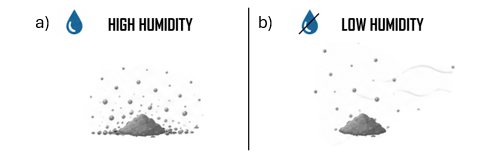
Image 2. Influence of humidity on odor behavior. a) High humidity, with greater retention of VOCs, and b) Low humidity, with faster dispersion and less defined scent plume.
Therefore, neither very dry nor extremely humid environments are always favorable. The important thing to understand is that environmental conditions change how scent is released, transported, and reaches the dog, so training and search interpretation must be adapted to those conditions.
- The dog also notices the heat.
Temperature and humidity not only affect how we perceive the scent in the environment, but also the dog’s physiological state. In high temperatures, the animal’s physical and cognitive performance can be compromised. Heat stress affects concentration, olfactory discrimination, and stamina during work, which can lead to a decrease in operational efficiency and overall performance of the detection dog.
Dogs regulate their temperature primarily through panting. When panting increases, the time they spend continuously sniffing decreases, and the dynamics of air ventilation through the nose change. This is compounded by the physical effort involved in working in high temperatures. The result is usually a progressive decrease in performance during long sessions.
Therefore, in summer it may be advisable to:
- Conduct shorter training sessions
- Increase rest periods
- Avoid the hottest hours of the day
- Ensure proper hydration
- Observe any changes in the dog’s usual search pattern
Not all performance declines indicate a training problem. Often, they simply reflect that the dog is working under much more demanding conditions.